Sergius of Radonezh
_2.jpg) Icon of Sergius of Radonezh, 17th century | |
| Born |
14 May 1314 Varnitsa, Rostov Veliky |
|---|---|
| Died |
25 September 1392 (aged 78) Trinity Lavra of St. Sergius |
| Nationality | Russian |
Sergius of Radonezh (Russian: Сергий Радонежский, romanized: Sergiy Radonezhsky; 14 May 1314 – 25 September 1392) was a Russian spiritual leader and monastic reformer.
He was the founder of the Trinity Lavra of St. Sergius near Moscow, what is now the most venerated monastic house in Russia.[1] He exerted the greatest influence of any personage on the Russian Orthodox Church..[2] Together with Seraphim of Sarov, he is one of the most highly venerated saints in Russia.
Historian Serge Aleksandrovich Zenkovsky wrote that Sergius, along with Epiphanius the Wise, Stephen of Perm, and the painter Andrei Rublev, signified "the Russian spiritual and cultural revival of the late fourteenth and early fifteenth century".[3]
Early life
The date of his birth is unclear: it could be 1314, 1319, or 1322. His medieval biography states that he was born to Kiril and Maria, a boyar family, near Rostov, on the spot where Varnitsy Monastery (Russian: Троице-Сергиев_Варницкий_монастырь now stands.[4]
The narrative of Epiphanius does not specify the exact birthplace of the monk, stating only that before the migration from Rostov principality the monk's family lived "in a village in the area, which is within the Rostov principality, not very close to the city of Rostov". It is considered that it is the village Varnitsa (Russian: Варница) near Rostov. Sergius received the baptismal name of Bartholomew (Russian :Варѳоломе́й, romanized: Varfolomei) in honor of the Apostle Bartholomew.
Although an intelligent boy, Bartholomew had great difficulty learning to read. His biography states that a starets (spiritual elder) met him one day and gave him a piece of prosphora (holy bread) to eat, and from that day forward he was able to read. Orthodox Christians interpret the incident as being an angelic visitation.
When the Rostov principality fell into the hands of van I of Moscow, his parents Kirill and Maria became impoverished and moved to Radonezh together with their three sons, Stefan, Bartholomew and Peter.
Monastic life

Upon his parents' death, Bartholomew went to Khotkovo near Moscow, where his older brother Stefan was a monk. He persuaded Stefan to find a more secluded place to live the ascetic life. In the deep forest at Makovets Hill they decided to build a small monastic cell and a church dedicated in honor of the Trinity. Thus started the history of the great Trinity-St. Sergius Lavra.
In time, Stefan moved to a monastery in Moscow. Varfolomei (Bartholomew) was tonsured a monk and given the name Sergius, following which he spent more than a year in the forest alone as a hermit. Soon, however, other monks started coming to him and building their own cells. After some time, they persuaded him to become their hegumen (abbot) and he was ordained to the priesthood. Following his example, all the monks had to live by their own labor. Over time, more and more monks and donations came to this place. Nearby, there appeared a posad which grew into the town of Sergiev Posad, and other villages.
When the news of Sergius's accomplishments reached Patriarch Philotheus of Constantinople, Philotheus sent a monastic charter to Sergius. During the reign of Dmitri Donskoi, his disciples started to spread his teaching across central and northern Russia. They settled intentionally in the most impracticable places and founded numerous monasteries, of which Borisoglebsky, Ferapontov, Kirillo-Belozersky and Vysotsky monasteries could be mentioned. Sergius was also connected with the foundation of two monastic communities in Moscow, Andronikov and Simonov monasteries. All in all, the disciples of Sergius founded about 40 monasteries, thus greatly extending the geographical extent of his influence and authority. Metropolitan Alexius, Metropolitan of Moscow asked Sergius to become his successor but Sergius declined, preferring to remain a simple monk rather than be a bishop.[5]
As an ascetic, Sergius did not take part in the political life of the country. However, he blessed Dmitry Donskoy when he went to fight the Tatars in the Battle of Kulikovo, but only after he was certain Dmitry had pursued all peaceful means of resolving the conflict. Sergius is said to have bestowed upon Dmitry the victory with the help of the monks Alexander Peresvet and Rodion Oslyabya.Some historians interpreted his political stance as aspiring to make peace and unite Russian lands under the leadership of Moscow.
Death and canonization

Sergius died on 25 September 1392. His incorrupt relics were found in 1422 and placed in the new cathedral of Troitse-Sergiyeva Lavra which he founded.
The exact year of his canonization by the Russian Orthodox Church is uncertain, either 1452[6][7][8] or 1448[9][10][11] .The church commemorates him on September 25, the date of his death, and on July 5, the day his relics were uncovered. (See ). Among the many affectionate titles given to him, he has been referred to as the "Abbot of Russia" and "valiant voivod" of the Russian land.[12]
The Catholic Church officially recognizes Sergius.[13]In 1940, he was included in the liturgical calendar authorized for the Russian Catholics.[14] Moreover, the most recent edition of the Roman Martyrology commemorates Sergius under the date of 25 September.[15]
Sergius is honored in the Calendar of Saints of several churches of the Anglican Communion and is remembered in the Church of England with a commemoration on 25 September[16]
The ecumenical Fellowship of Saint Alban and Saint Sergius is named in part for him.
In December 1937, Pavel Florensky (1882–1937), a Russian theologian, priest, mathematician, inventor, philosopher and engineer died in the Soviet Gulag and it is thought he was condemned by an extrajudicial NKVD troika under NKVD Order No. 00447 to be executed during the 1930s Bolshevik purges after refusing to disclose the hiding place of Sergius' head which the Bolsheviks wanted destroyed. It is rumored that Florensky and other theologians were involved in a plot to save and hide the relics of St. Sergius. The relics were returned by Pavel Golubtsov, later "Archbishop Sergius", to the cathedral of Troitse-Sergiyeva Lavra in 1946 when it was reopened.[17]
Miracles
Epiphanius the Wise, the first compiler of St. Sergius's Life, reports numerous miracles associated with St. Sergius, which are completely absent in the biography of Stephen of Perm written by the same Epiphanius. In particular, as Epiphanius reports, one of these miracles preceded the birth of the future saint:
"And a certain miracle occurred before his birth: something happened that cannot be consigned to silence."
"When the child was still in his mother's womb, once—it was on a Sunday—his mother entered the church as usual during the singing of the holy liturgy," and before the reading of the Gospel, "suddenly the infant began to cry in his mother's womb." Before the singing of "Let Us Who Mystically Represent the Cherubim," the cry was repeated: "suddenly the infant began to cry loudly in the womb for a second time, louder than the first time," and for the third time, the infant cried loudly after the priest's exclamation: "Let us attend, the holy things for the holy!"
Another episode related to the miraculous help received by young Bartholomew was described above in the section "Miraculous Learning of Letters," and is reflected in the painting "The Vision to Young Bartholomew," in sculpture, and in iconography.
Miracles Through the Prayers of St. Sergius of Radonezh
According to the Life, St. Sergius of Radonezh himself performed many miracles.
Church historian E. E. Golubinsky in his work lists the following miracles of the saint:
- The creation of a spring Since "the monks were forced to bring water from afar," murmuring arose, and then the venerable one, "finding a little rainwater in a ditch, made an earnest prayer over it," after which an abundant source of water opened up.
- Resurrection of a child. A local resident, having a severely ill son, carried him to St. Sergius. But when he entered the saint's cell and asked for prayers for the sick, his son died. Grief-stricken, he left to get a coffin. "But while he was gone, the venerable one prayed over the dead—and by his prayer the child came back to life."
- Healing of a possessed nobleman.
- Healing of a man suffering from insomnia, who "for twenty days did not eat or sleep."
- Punishment of an extortionist who "forced a poor neighbor to give up his boar" and "did not want to pay money for it." Sergius addressed the offender with rebuke and heard in response a promise not only to "pay for the pig taken from the poor neighbor, but also to correct his entire life," which he soon forgot, and the pig's carcass was eaten by worms, "although it was wintertime."
- Healing of a Greek bishop. "Hearing many stories about St. Sergius, he did not want to believe them..." But upon meeting the saint, "he was struck with blindness," "and unwillingly confessed his disbelief to the venerable one," after which St. Sergius restored his sight.
Miraculous Visions
The Life of St. Sergius contains descriptions of two miraculous visions. One of them is as follows: late in the evening or at night, "a bright light appeared in the sky, which dispersed all the night darkness," and Sergius
"saw many very beautiful birds that flew not only to the monastery but also to the surroundings of the monastery. And a voice was heard saying: 'As many birds as you have seen, so will your disciples multiply, and after you they will not be exhausted if they wish to follow in your footsteps.'"
Additionally, according to the Life, the Mother of God appeared to St. Sergius "with two apostles, Peter and John."
Interpretation of Miracle Accounts
The interpretation of miracles, or more precisely, reports of miracles, depends, of course, on the worldview of the interpreter. Obviously, a materialistically inclined researcher would most likely either prefer to ignore information about miracles or try to give it some other (symbolic, allegorical) interpretation. For example, B. M. Kloss proposed to interpret the miracle described above (the triple cry of the unborn infant) as an indication of St. Sergius's birth date, rather than as an actual event.
When was Sergius of Radonezh born? (K. A. Averyanov) In determining the possible time of Sergius's birth, B. M. Kloss pointed out that Epiphanius in the "Life" cites a legend that Bartholomew's birth was accompanied by signs that were interpreted to mean that he "will appear as a disciple of the Holy Trinity" and "a chosen vessel of the Holy Spirit." The latter phrase can be interpreted as a reference to the church feast of the Descent of the Holy Spirit on the apostles, celebrated on the 50th day after Easter. In 1322, it fell on May 30.
Interestingly, Epiphanius himself resorts to symbolic interpretation of the miracle. He "tries to explain, first, why the miracle occurred, and second, why the infant 'cried out' specifically in church and specifically three times":
"Seeing in the miracle that occurred a Divine foreshadowing and testimony of the child's divine election, Epiphanius interprets it in symbolic images, as well as through historical analogy."
The Meaning of Miracles
In 2014, Patriarch Kirill in an interview with "Expert" magazine explained that "the meaning of miracles is not in the very fact of violating the laws of nature, but in confirming the closeness of man to God, for Whom all things are possible."
A miracle, the Patriarch noted, appears "where faith is unstable": it allows faith to be strengthened, encourages it, but does not force it, since the inquisitive mind always has the opportunity to "try to explain the miracle by natural causes." Deep faith seeks not miracles but God, the Patriarch noted, and added:
"The main miracle of St. Sergius is himself."
Thus, according to Patriarch Kirill, a miracle is, first of all, moral transformation and moral perfection.
Klyuchevsky's Commentary
The idea that miracles in the life of the Saint are not reduced to unusual events was also expressed by the 19th century Russian Orthodox historian Vasily Klyuchevsky, who noted that St. Sergius, by the example of his own life, "raised the fallen spirit of his native people, awakened in them confidence in themselves," showed the Russian people that "not all good in them had been extinguished and died":
"...he opened their eyes to themselves, helped them look into their own inner darkness and discern there the still smoldering sparks of the same fire that burned in the light that illuminated them. Russian people of the 14th century recognized this action as a miracle, [...] because its source is faith."
Legacy
Much information about Sergius and his acts is taken from the writing of his life composed in the 15th century, which has come down to us in many later editions in the 15th to 20th century Russian manuscripts. The memory of Sergius of Radonezh has lived on thanks to the unique manuscript entitled "The Life of St. Sergius of Radonezh" written by famous hagiographer Pachomius the Serb, also known as Pachomius Logothetes. The original manuscript is housed in the National Library of Russia.
Historian Serge Aleksandrovich Zenkovsky wrote that Sergius, along with Epiphanius the Wise, Stephen of Perm, and the painter Andrei Rublev, signified "the Russian spiritual and cultural revival of the late fourteenth and early fifteenth century".[3]
-
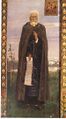 Icon of Sergius of Radonezh painted for Abramtsevo church by Viktor Vasnetsov, 1882.
 -
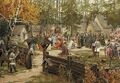 Sergius of Radonezh blessing Dmitri Donskoi before the Battle of Kulikovo in a painting by Ernst Lissner.
 -
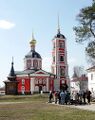 Varnitsy Monastery of St. Sergius commemorates the saint's birthplace.
 -
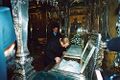 The reliquary containing the relics of Saint Sergius at the Catholicon of Holy Trinity-St. Sergius, Lavra, Sergiev Posad.
 -
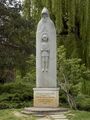 Statue of Saint Sergius of Radonezh by Vyacheslav Klykov in Danube Park, Novi Sad, Serbia, 1992.
 -
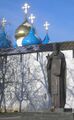 Statue of Sergius outside the Trinity Lavra.


References
- ↑ Kent, Neil (2021). A Concise History of the Russian Orthodox Church. Academica Press. p. 18. ISBN 978-1-68053-907-3.
- ↑ Kent, Neil (2021). A Concise History of the Russian Orthodox Church. Academica Press. p.18. ISBN 978-1-68053-907-3.
- ↑ 3.0 3.1 Serge A. Zenkovsky, Medieval Russia's Epics, Chronicles, and Tales, Revised Edition, (New York, 1974), p. 259
- ↑ Nikon Christmas (archbishop) (2003). Житие и подвиги преподобного Сергия Радонежского [The Life and Deeds of St. Sergius of Radonezh] (in Russian). Moscow: Trifonov Pechenga Monastery. pp. 32–33.
- ↑ An Episcopal Dictionary of the Church. Sergius of Radonezh. The Episcopal Church. Retrieved February 1, 2025, from [1]
- ↑ Сергий Радонежский. История Отечества с древнейших времен до наших дней. Большая российская энциклопедия (издательство)
- ↑ Кучкин, Владимир Андреевич. Сергий Радонежский .Great Soviet Encyclopedia.
- ↑ Gritsanov, Alexander Alekseevich; Sinilo, G. V., eds. (2007). Сергий Радонежский. Религия: Энциклопедия. Книжный Дом. Page 960.
- ↑ Собрание государственных грамот и договоров. М., 1813. Том 1. № 63, 68.
- ↑ Смирнов, Михаил Иванович. Культ Сергия Радонежского (Исторический очерк) // Антирелигиозник. 1940. № 5—6. С. 32—39.
- ↑ Филимонов С. Б. Обзор архива М. И. Смирнова // Археографический ежегодник за 1971 г. М., 1972. С. 318—324.
- ↑ Simeon Shakhovsky, Akathist to St Sergius
- ↑ Father Edward McNamara, LC. Honoring Eastern Orthodox Saints. EWTN Global Catholic Television Network. Retrieved July 31, 2025 from [2]
- ↑ Butler,Alban; Thurston, Herbert; Attwater, Donald. (1956). Butler's Lives of the Saints. New York: P.J. Kenedy & Sons. p. 639
- ↑ Martyrologium Romanum, editio altera, (Typis Vaticanis, 2004, p. 536 Template:ISBN)
- ↑ The Calendar .The Church of England.(s. d). Retrivied 2021-04-08 from [3]
- ↑ Maccioni, Antonio. "Pavel Aleksandrovič Florenskij. Note in margine all'ultima ricezione italiana" in eSamizdat (2007) V:(1-2):471-478. In Italian.
Sources
- Kent, Neil (2021). A Concise History of the Russian Orthodox Church. Academica Press. 978-1-68053-907-3.
External links
- Official site of the Trinity-St. Sergius Lavra
- Repose of the Venerable Sergius, Abbot and Wonderworker of Radonezh Orthodox icon and synaxarion
- Uncovering of the relics of the Venerable Sergius of Radonezh
Credits
- Wikipedia contributors. (2025, January 27). Sergius of Radonezh. In Wikipedia, The Free Encyclopedia. Retrieved 19:09, February 2, 2025, from https://en.wikipedia.org/w/index.php?title=Sergius_of_Radonezh&oldid=1272264310
License
- Copyright © Creative Commons Attribution-ShareAlike 4.0 License; additional terms may apply.